



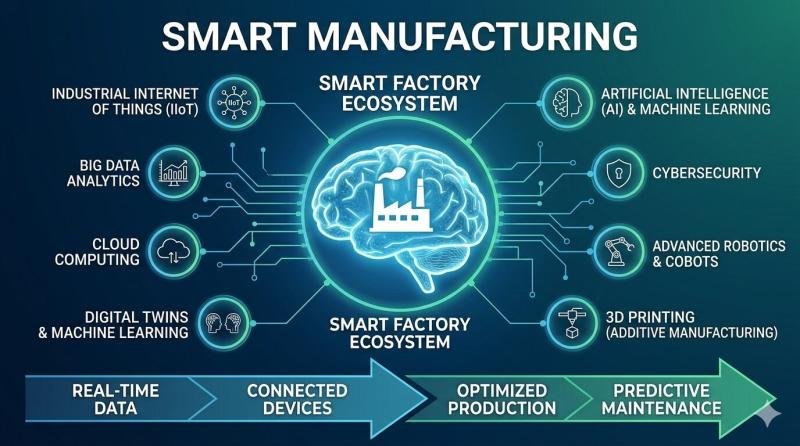
Smart Manufacturing Market
The Smart Manufacturing Market reached approximately US$ 258.2 billion in 2024 and is expected to grow to around US$ 546.8 billion by 2029, expanding at a CAGR of about 16.2% from 2025 to 2029 as manufacturers worldwide accelerate digital transformation to boost productivity, agility, and competitiveness.
Growth is supported by rising adoption across key solution areas such as industrial IoT (IIoT), advanced robotics, AI-driven analytics, digital twins, and cloud-based manufacturing execution systems (MES), driven by the need to optimize operations, reduce downtime, and enable real-time decision-making. Integration of predictive maintenance, automation platforms, and edge-to-cloud connectivity further enhances process efficiency and cost savings. Additionally, increasing investments in Industry 4.0 initiatives, expansion of smart factory deployments, and supportive government policies for advanced manufacturing continue to propel broad utilization of smart manufacturing solutions and services worldwide.
Download your exclusive sample report today (corporate email gets priority access):
https://www.datamintelligence.com/download-sample/smart-manufacturing-market?sindhuri
Smart Manufacturing Market: Competitive Intelligence
Siemens AG, Rockwell Automation Inc., ABB Ltd., Honeywell International Inc., Schneider Electric SE, GE Digital (General Electric Company), Dassault Systèmes SE, PTC Inc., SAP SE, and others.
The Smart Manufacturing Market is strongly driven by leading industrial automation, digital transformation, and software solution providers such as Siemens AG, Rockwell Automation Inc., ABB Ltd., Honeywell International Inc., and Schneider Electric SE, who offer comprehensive smart manufacturing platforms that integrate industrial IoT (IIoT), data analytics, AI-enabled insights, digital twin models, advanced robotics, and edge-to-cloud connectivity to optimize production processes, asset performance, and operational decision-making across discrete and process industries. Their solutions help manufacturers improve productivity, reduce downtime, enhance quality, and accelerate Industry 4.0 adoption across automotive, electronics, aerospace, oil & gas, chemicals, and consumer goods sectors.
Rapid industrial digital transformation initiatives, increasing adoption of connected devices and sensors, rising demand for real-time visibility into production operations, stringent cost-efficiency and sustainability mandates, and growing requirement for flexible and resilient supply chains are key factors fueling market growth. Additionally, advancements in predictive maintenance, autonomous robotics, augmented reality (AR) for remote support, and integrated manufacturing execution systems (MES) further accelerate smart factory deployments in both mature and emerging economies.
These companies’ complementary strengths comprehensive automation and control portfolios from Siemens, ABB, and Rockwell; integrated process and safety systems from Honeywell and Schneider Electric; advanced analytics, simulation and PLM software from Dassault Systèmes and SAP; IIoT platforms and connectivity solutions from GE Digital; and scalable industrial software and AR-enabled solutions from PTC enhance competitive positioning across the smart manufacturing ecosystem. Strategic focus areas include development of AI-driven decision engines, expansion of digital twin and simulation capabilities, end-to-end security and data governance frameworks, open interoperability standards for multi-vendor environments, and strategic partnerships with OEMs, system integrators, and industrial enterprises to drive large-scale smart manufacturing adoption.
Get Customization in the report as per your requirements:
https://www.datamintelligence.com/customize/smart-manufacturing-market?sindhuri
Recent Key Developments – United States & North America
✅ June 2025: General Electric expanded its smart factory initiatives across North America, integrating AI-driven predictive maintenance and digital twin technologies to enhance production efficiency and reduce downtime.
✅ May 2025: Honeywell International Inc. introduced advanced industrial IoT (IIoT) platforms with real-time analytics and cybersecurity enhancements to support connected manufacturing ecosystems.
✅ 2025: U.S. manufacturers accelerated Industry 4.0 investments, focusing on robotics automation, cloud-based manufacturing execution systems (MES), and data-driven supply chain optimization to strengthen resilience and operational agility.
Recent Key Developments – Japan & Asia-Pacific
✅ July 2025: Siemens AG expanded deployment of smart manufacturing solutions across Asia-Pacific, integrating AI, edge computing, and digital twin capabilities within advanced production facilities.
✅ Early 2026: Fanuc Corporation launched next-generation industrial robots equipped with AI-based vision systems and collaborative automation features to enhance precision and flexibility in manufacturing lines.
✅ 2025: Rapid industrial digitization in China, India, South Korea, and Southeast Asia drove adoption of smart sensors, automated quality inspection systems, and cloud-integrated production management platforms.
Recent Key Developments – Product & Technology Innovation
✅ 2025: AI & Predictive Analytics Integration: Manufacturers increasingly adopted AI-powered analytics platforms to optimize equipment performance, reduce downtime, and improve product quality.
✅ Digital Twin & Simulation Models: Advanced digital twin technologies enabled real-time monitoring and simulation of production processes, improving efficiency and minimizing operational risks.
✅ Edge Computing & Cybersecurity Enhancements: Deployment of edge-enabled IIoT devices with enhanced cybersecurity frameworks ensured secure data exchange and low-latency decision-making in smart factories.
✅ 1. M&A / Strategic Activity
Strategic acquisitions and partnerships accelerating Industry 4.0 adoption
Siemens AG – Expanding digital twin & industrial software ecosystem
Siemens continues strengthening its digital manufacturing capabilities through targeted industrial software integrations and expansion of its Xcelerator portfolio. The company is deepening its footprint in digital twin technology, industrial IoT (IIoT), and AI-enabled factory automation platforms.
Rockwell Automation – Strategic collaboration with NVIDIA for AI-powered factories
Rockwell Automation partnered with NVIDIA to integrate AI, simulation, and edge computing into smart factory environments. The collaboration enhances real-time analytics, robotics optimization, and predictive maintenance systems.
Honeywell International Inc. – Industrial IoT & cybersecurity expansion
Honeywell continues investing in industrial cybersecurity and connected operations platforms to support smart plant deployments, especially across oil & gas, chemicals, and heavy manufacturing sectors.
✅ 2. New Product Launches & Deployments
Next-generation factory intelligence solutions entering the market
AI-Driven Manufacturing Platforms
Manufacturers are launching AI-enabled production management systems that integrate MES (Manufacturing Execution Systems), robotics, and machine analytics for autonomous decision-making.
Industrial Edge & 5G Integration
Deployment of private 5G networks inside factories is enabling ultra-low latency automation, real-time robotic coordination, and digital twin simulation environments.
Collaborative Robotics (Cobots) Expansion
Companies are introducing next-gen collaborative robots capable of working safely alongside human operators, improving productivity and labor efficiency in electronics, automotive, and food processing industries.
Cloud-Based Manufacturing Suites
Vendors are expanding SaaS-based manufacturing platforms that provide remote plant monitoring, asset tracking, and centralized production optimization dashboards.
Deployment Trend:
Smart factories are increasingly adopting integrated ecosystems combining IoT sensors, robotics, AI analytics, and cloud infrastructure, shifting from isolated automation to fully connected production environments.
✅ 3. R&D & Technological Advancements
AI & Predictive Analytics
AI-driven predictive maintenance systems are reducing unplanned downtime by analyzing vibration, temperature, and operational data in real time. Machine learning models now predict equipment failure before breakdowns occur.
Digital Twin Technology
Digital twin simulations allow manufacturers to model entire production lines virtually, optimize throughput, reduce waste, and test process changes before physical implementation.
Advanced Robotics & Autonomous Systems
Autonomous mobile robots (AMRs) are transforming warehouse logistics and material handling operations within smart manufacturing facilities.
Industrial Cybersecurity Innovation
As connectivity increases, cybersecurity platforms tailored for operational technology (OT) environments are being developed to prevent industrial cyber threats.
Additive Manufacturing Integration
3D printing is increasingly integrated into smart manufacturing workflows for rapid prototyping, tooling, and customized component production.
✅ Market Drivers & Emerging Trends
» Industry 4.0 Adoption Acceleration – Manufacturers worldwide are digitizing operations to improve efficiency, agility, and cost control.
» Rising Demand for Operational Efficiency – Real-time analytics and automation reduce labor costs, improve yield, and enhance quality control.
» Labor Shortages in Manufacturing – Automation and robotics offset workforce shortages in developed economies.
» Sustainability & Energy Optimization – Smart manufacturing systems optimize energy consumption and reduce carbon emissions through intelligent energy management.
» Mass Customization Demand – Flexible production systems enable personalized product manufacturing at scale.
» Government Digitalization Initiatives – National manufacturing transformation programs across the U.S., Germany, China, India, and Japan are supporting smart factory investments.
Buy Now & Unlock 360° Market Intelligence:
https://www.datamintelligence.com/buy-now-page?report=smart-manufacturing-market?sindhuri
Segments Covered in the Smart Manufacturing Market:
By Information Technology
The market is segmented into manufacturing execution systems (MES) (25%), enterprise manufacturing intelligence (20%), warehouse management systems (15%), plant asset management (15%), human machine interface (HMI) (15%), and industrial communications (10%).MES dominates due to its critical role in real-time production monitoring, workflow optimization, and quality management. Enterprise manufacturing intelligence is growing steadily with demand for data-driven decision-making and predictive analytics. Warehouse management systems support supply chain visibility and inventory optimization. HMI and industrial communications are essential for seamless machine-to-machine (M2M) connectivity and operator interaction. Increasing digital transformation initiatives and Industry 4.0 adoption drive segment growth.
By Enabling Technology
Enabling technologies include industrial Internet of Things (IIoT) (30%), artificial intelligence (AI) in manufacturing (20%), industrial cybersecurity (15%), industrial machine vision (12%), machine condition monitoring (10%), industrial 3D printing (8%), and others (5%).IIoT dominates due to widespread deployment of connected sensors, real-time monitoring systems, and smart factory solutions. AI in manufacturing is expanding rapidly for predictive maintenance, quality inspection, and production optimization. Industrial cybersecurity is increasingly critical to protect connected infrastructure from cyber threats. Machine vision and condition monitoring enhance operational efficiency and reduce downtime. Growing automation and smart factory investments accelerate adoption across technologies.
By Industry
Industries include automotive (20%), energy & power (15%), oil & gas (15%), chemicals (12%), healthcare (10%), food & agriculture (10%), metals & mining (8%), aerospace (5%), pulp & paper (3%), and others (2%).Automotive leads due to high adoption of robotics, AI-driven production lines, and digital twins. Energy & power and oil & gas sectors implement smart manufacturing to improve operational efficiency and asset reliability. Chemicals and healthcare leverage automation for precision production and regulatory compliance. Food & agriculture adopts smart solutions for traceability and quality control. Increasing demand for cost optimization and supply chain resilience supports industry-wide growth.
Regional Analysis
Asia Pacific – 35% Share
Asia Pacific dominates driven by rapid industrialization, strong manufacturing base, and government-backed Industry 4.0 initiatives in China, Japan, South Korea, and India. Smart factory investments and expanding electronics and automotive production boost regional growth.
North America – 28% Share
North America holds a significant share supported by advanced technological infrastructure, strong adoption of AI and IIoT, and presence of leading smart manufacturing solution providers. The United States leads with high investments in automation and digital transformation.
Europe – 25% Share
Europe accounts for a considerable share due to strong industrial automation in Germany, France, and the UK. Industry 4.0 strategies, sustainability goals, and advanced robotics adoption drive market expansion.
Request for 2 Days FREE Trial Access:
https://www.datamintelligence.com/reports-subscription?sindhuri
✅ Competitive Landscape
✅ Technology Roadmap Analysis
✅ Sustainability Impact Analysis
✅ KOL / Stakeholder Insights
✅ Consumer Behavior & Demand Analysis
✅ Import-Export Data Monitoring
✅ Live Market & Pricing Trends
Contact Us –
Company Name: DataM Intelligence
Contact Person: Sai Kiran
Email: Sai.k@datamintelligence.com
Phone: +1 877 441 4866
Website: https://www.datamintelligence.com
About Us –
DataM Intelligence is a Market Research and Consulting firm that provides end-to-end business solutions to organizations from Research to Consulting. We, at DataM Intelligence, leverage our top trademark trends, insights and developments to emancipate swift and astute solutions to clients like you. We encompass a multitude of syndicate reports and customized reports with a robust methodology.
Our research database features countless statistics and in-depth analyses across a wide range of 6300+ reports in 40+ domains creating business solutions for more than 200+ companies across 50+ countries; catering to the key business research needs that influence the growth trajectory of our vast clientele.
This release was published on openPR.
